Four Things a Synchronous Blackboard Strategy Can't Do
The blackboard architecture is 40 years old. Hayes-Roth described it in 1985 for HEARSAY-II speech recognition. The idea — a shared workspace where independent knowledge sources self-organise around a problem, activated opportunistically as data accumulates — is genuinely elegant, and it is having a significant revival in multi-agent LLM systems.
But the canonical implementation has a problem nobody talks about, because in 1985 it didn’t matter: the control shell is synchronous.
In Hayes-Roth’s model, the control shell evaluates which knowledge sources are eligible, selects among them, and fires the winner. That selection is a function call. It blocks. It returns. The rest of the system waits.
For most of the past four decades, that was fine. Today, if your knowledge sources are LLM calls, if the control shell wants to consult historical execution data before selecting, or if you’re running on a reactive event loop where blocking is a correctness violation — the synchronous shell is a ceiling, not a foundation.
What the Synchronous Shell Actually Prevents
Consider a planning strategy that makes a non-trivial selection decision. It wants to look at the last five executions of this case type, check which knowledge sources produced high-quality results, and bias the current selection toward those. Reasonable. Useful. Exactly the kind of learned control Hayes-Roth was gesturing at with the concept of “meta-level knowledge sources.”
In a synchronous shell, the strategy receives the current blackboard state and returns a ranked list. That is all it has access to. The interesting data — the execution history, confidence signals, external context — is in an event log, which requires an I/O call. A synchronous strategy cannot make that call without blocking the event loop. On Vert.x, blocking the event loop is not a performance problem — it is a correctness failure.
The fix requires changing the LoopControl interface from a blocking contract to a reactive one:
// Classical — selection is synchronous, blocking
List<Binding> select(PlanExecutionContext context, List<Binding> eligible);

// Reactive — selection is a Uni, fully non-blocking
Uni<List<Binding>> select(PlanExecutionContext context, List<Binding> eligible);
The default ChoreographyLoopControl wraps its result in
Uni.createFrom().item(eligible) — no behaviour change, zero cost. But
PlanningStrategyLoopControl can now delegate to a strategy whose
select() method chains EventLog queries, calls an LLM scorer, or checks
any external system — all without blocking:
public Uni<List<Binding>> select(PlanExecutionContext ctx, List<Binding> eligible) {
    CasePlanModel plan = getOrCreate(ctx.getCaseId());
    return planningStrategy.select(plan, ctx, eligible);  // fully async
}
That one interface change enables four things the synchronous model cannot do.
Four Concrete Improvements
1. Strategies that reason over history. An async PlanningStrategy can
query the EventLog — which knowledge sources fired recently, which produced
valuable outputs, which ran and left the blackboard unchanged. Selection
based on observed outcomes rather than declared priority. This is what
Hayes-Roth meant by control knowledge sources learning from the problem-solving
record; the synchronous shell just made it impractical.
2. Stage lifecycle as first-class events. In the classical model, stage activation and completion are internal state mutations — the control shell updates its own data structures and moves on. In a reactive model, stage transitions are published onto the event bus:
eventBus.publish(STAGE_ACTIVATED, new StageActivatedEvent(caseId, stage));
eventBus.publish(STAGE_COMPLETED, new StageCompletedEvent(caseId, stage));
Other components — observability, lineage trackers, dashboards — can react without coupling. The stage lifecycle becomes auditable and hookable without touching the engine internals.
3. PlanItem completion tracking without polling. Worker execution
completion in casehub-engine is published via eventBus.publish() — a
fan-out, not a point-to-point send. The blackboard module adds a second
consumer on the same address. When a worker finishes, the CasePlanModel
updates immediately: the corresponding PlanItem is marked COMPLETED,
Stage autocomplete criteria are re-evaluated. No polling loop, no tight
coupling.
4. Separation of domain state from control state. The CasePlanModel
is Hayes-Roth’s “control blackboard” — per-case, keyed by UUID, holding the
scheduling agenda, current focus of attention, resource budget, and stage
tracking. Strategies read and write it. The engine reads the selection result.
Domain state (CaseContext) and control state (CasePlanModel) never mix.
This is the architecture Hayes-Roth described; the synchronous shell made it
a formality rather than a functional separation.
What Recent Research Confirms
The academic literature is catching up to these architectural directions. A 2024 paper (arXiv 2510.01285) demonstrates LLM-based blackboard multi-agent systems outperforming baseline static frameworks on five of six benchmarks, attributing the gains explicitly to dynamic agent selection and shared memory. A companion paper (2507.01701) shows the performance and cost improvements come from two sources: the shared memory pool enabling comprehensive information exchange, and dynamic agent selection ensuring only suitable agents are activated for each blackboard state.
Both depend on control reasoning that is more than a priority sort over a static list. The async shell is the mechanism that makes richer control reasoning tractable.
Opt-In Orchestration
The practical consequence for casehub-engine users: add the
casehub-blackboard module and you get pure choreography unchanged.
ChoreographyLoopControl fires all eligible bindings — the default behaviour.
Add a PlanningStrategy CDI bean and the PlanningStrategyLoopControl
alternative, and the engine switches to orchestration without changing a
line of application code or touching the engine core.
The upgrade path is opt-in, the control contract is reactive throughout, and strategies have access to the full context the event loop provides — including anything a non-blocking I/O call can reach.
One Loop, One Hook Point
A common question: if the engine already has a control loop, what is the blackboard’s control loop doing? Are there two loops? Do they conflict?
There is one loop. The engine’s reactive Vert.x EventBus cycle drives
everything — it always runs, with or without casehub-blackboard on the
classpath. What changes is what happens at a single hook point inside that
loop: loopControl.select().
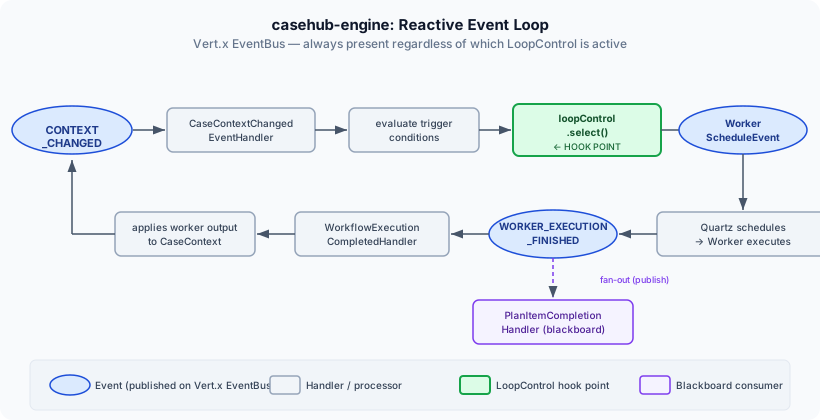
On every CONTEXT_CHANGED event, CaseContextChangedEventHandler evaluates
trigger conditions and produces a list of eligible bindings. It then hands that
list to loopControl.select() and waits for the answer. That answer determines
which workers fire.
By default, ChoreographyLoopControl answers “all of them” — one line, the
identity function. PlanningStrategyLoopControl from casehub-blackboard
replaces it via @Alternative @Priority(10) and answers differently: it
evaluates stage lifecycle, consults the per-case plan model, then delegates to
PlanningStrategy, which can do anything a non-blocking Uni allows before
returning its selection.
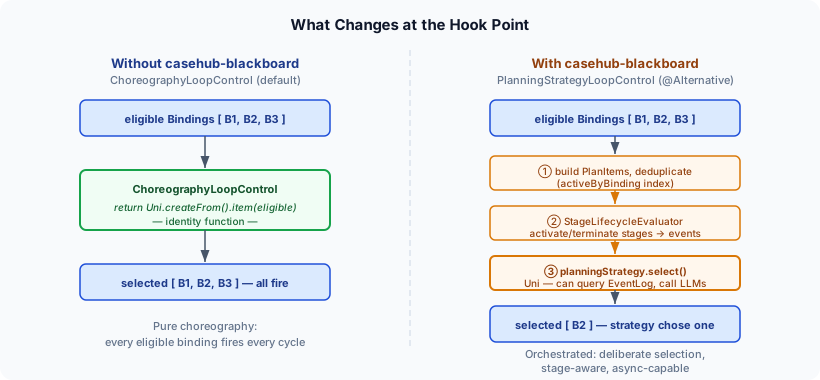
The engine loop is unchanged. The selection function is replaced. That is the entire integration surface.
The Full Picture
Below is how all the blackboard components wire together with the engine on every cycle.
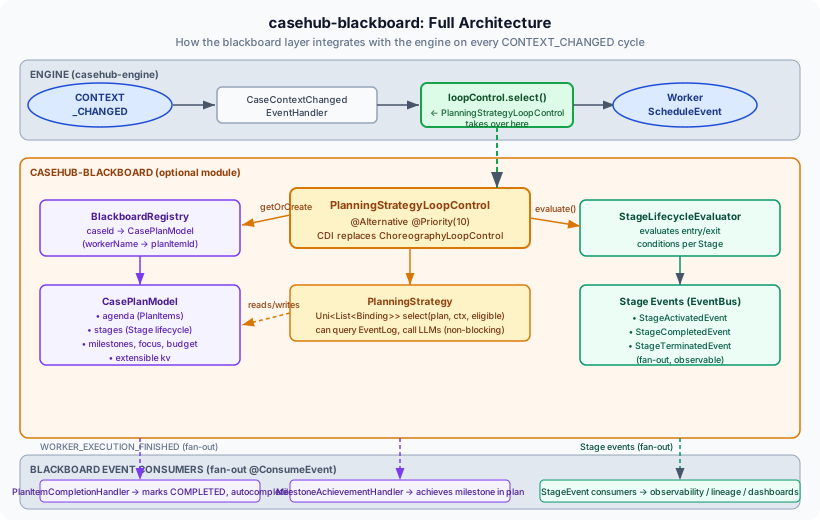
PlanningStrategyLoopControl coordinates three things on each select() call:
it builds PlanItems for newly eligible bindings (via BlackboardRegistry,
which owns the per-case CasePlanModel), runs StageLifecycleEvaluator to
activate and terminate stages and publish their lifecycle events, then delegates
to PlanningStrategy which returns the final selection.
Separately, two @ConsumeEvent handlers run on the engine’s fan-out events:
PlanItemCompletionHandler listens to WORKER_EXECUTION_FINISHED and marks
plan items complete — triggering stage autocomplete when all required items
are done. MilestoneAchievementHandler listens to MILESTONE_REACHED and
promotes tracked milestones to ACHIEVED in the plan model.
Neither handler interferes with the engine’s own processing of the same events.
Fan-out (eventBus.publish()) means both the engine and the blackboard receive
every event independently.
The synchronous control shell was a constraint of its era. It doesn’t need to be a constraint of ours.