Wanted a Sketch, Got a Framework
Date: 2026-03-27 Type: day-zero
The assignment I gave my colleague
I’d asked a colleague to look at case management in Kogito — the jBPM and SonataFlow family — specifically around flexible processes and CMMN. The KIE blog has a reasonable series on it. I wanted him to bring in choreography more strongly, and to take a fresh look at CMMN in the context of what we were building.
One instruction I was clear about: don’t make it process-centric. Kogito’s case management is good work, but it sits inside a process engine. Everything is framed through that lens. Case Management was never successful in the BPM world partly for this reason — business users couldn’t shift their mental model away from process-centric thinking, even when the underlying concepts were a better fit for their problem. The Blackboard pattern and CMMN aren’t process-centric. For Agentic AI — where you have multiple specialists reasoning over shared context, not a sequence of steps executing in order — that distinction matters. Approaching it with fresh eyes through a process-centric frame would be misleading.
What I hadn’t yet articulated
Here’s what I didn’t tell him, partly because I hadn’t fully worked it out myself: the connection between the Blackboard Architecture and CMMN is closer than it first appears. Hayes-Roth’s 1985 Blackboard model — shared workspace, independent knowledge sources, a control component — maps almost directly onto CMMN’s CaseFile, TaskDefinitions, and PlanningStrategy. The terminology is different; the structure is largely the same.
I had a sense of this. I hadn’t verified it. And I certainly hadn’t investigated whether any standalone Java implementation of it existed.
The gap that made it worth building
Before sketching anything, I’d done some investigation with Claude into what already existed. The answer was: not much. No standalone Java Blackboard implementation that wasn’t already embedded inside a larger platform. Everything found was either a research prototype, tightly coupled to a specific framework, or buried inside something bringing far more than you’d want.
I wanted something different. Standalone — not a platform, no mandatory infrastructure. Quarkus-native, able to run lean and go native. And designed to work well with the ecosystem we already use: LangChain4J for AI agents, Quarkus Flow for workflow execution, Drools for rule-based reasoning. A Blackboard coordinator that integrated cleanly with all three would be genuinely useful.
The specific thing I wanted to go deep on
Distributed context propagation. How do you track lineage across a hierarchy of cases and tasks? How does a budget flow from a parent case into child cases? How do you get W3C-compatible trace IDs threaded through everything without coupling every component to a tracing framework?
The plan: sketch the broader architecture, go deep on that one specific part. Something concrete enough that my colleague could react to.
What Claude did with that
I started a session. Described the concept, the Blackboard pattern, what I was trying to show. I expected scaffolding. Something to react to.
Claude went further. It didn’t just sketch the control loop — it built it. CaseEngine, CasePlanModel, PlanItem, PlanningStrategy. Then CaseFile with per-key versioning and change listeners. Then TaskDefinition with DFS cycle detection to prevent circular dependencies at registration time. Then a full resilience layer: RetryPolicy, PoisonPillDetector, DeadLetterQueue, IdempotencyService, TimeoutEnforcer, ConflictResolver. Then TaskBroker, TaskScheduler, WorkerRegistry. Two working example applications. LLM worker integration.
And the distributed context — PropagationContext carrying a W3C trace ID, inherited attributes, a deadline, a remaining budget. Exactly what I’d intended to sketch deeply. More complete than I would have produced alone.
A 2,400-line design document appeared alongside it. Working through it, I could see the Blackboard/CMMN overlap laid out in front of me — more clearly than I’d understood it before starting.
I hadn’t asked for most of this. I didn’t want to stop it.
73 files, 14,003 lines, 2:33am
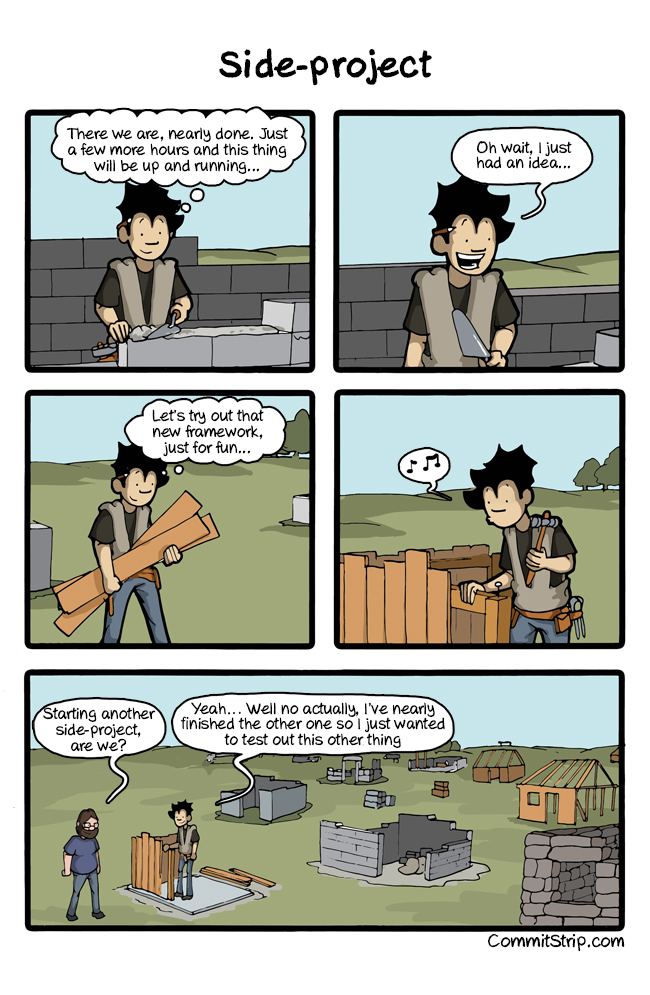
One session. I’d gone in wanting to clarify my own thinking and give my colleague something concrete. What came out was a framework — and a clearer view of the architectural territory than I’d had when I started.
I let it run because I wanted to see how far it would go. The subsequent sessions would keep answering that question.